<活動> 3GPP標準進度推廣研討會 日期: 2026.04.28(二)
<活動>3GPP標準進度推廣研討會 日期: 2026.04.28(二)
學界的 3GPP 分享會即將於 4/28(二) 下午 1:00-5:30 中山大學舉行,這是我們每半年一次的重要盛會!
邁入 2026 年年中,3GPP 第 20 版(Rel-20)標準制定正如火如荼推進中,持續深化 5G-Advanced 系統能力,同時加速 6G 關鍵技術研究與標準化布局,成為銜接現行行動通訊與未來世代網路的重要發展節點。
在本次分享會中,我們將聚焦 3GPP Rel-20 的最新標準進展,深入探討 ISAC 技術的架構演進與應用情境,以及 AI/ML 在無線通訊系統中的標準化發展與關鍵挑戰。同時,也將解析 6G 中智慧空中介面設計的新興用例,包括通道估測、資源管理與 AI 驅動服務型通訊等前瞻議題,帶領與會者掌握未來通訊技術的重要脈動。
我們誠摯邀請學界與業界的專家、教授及碩博士生一同參與,透過交流與討論激盪創新思維,共同探索通訊與智慧技術融合的無限可能。
這是一次不容錯過的機會,歡迎大家踴躍報名參加!
線上報名: https://www.beclass.com/rid=30525e769c61a4eb71a0
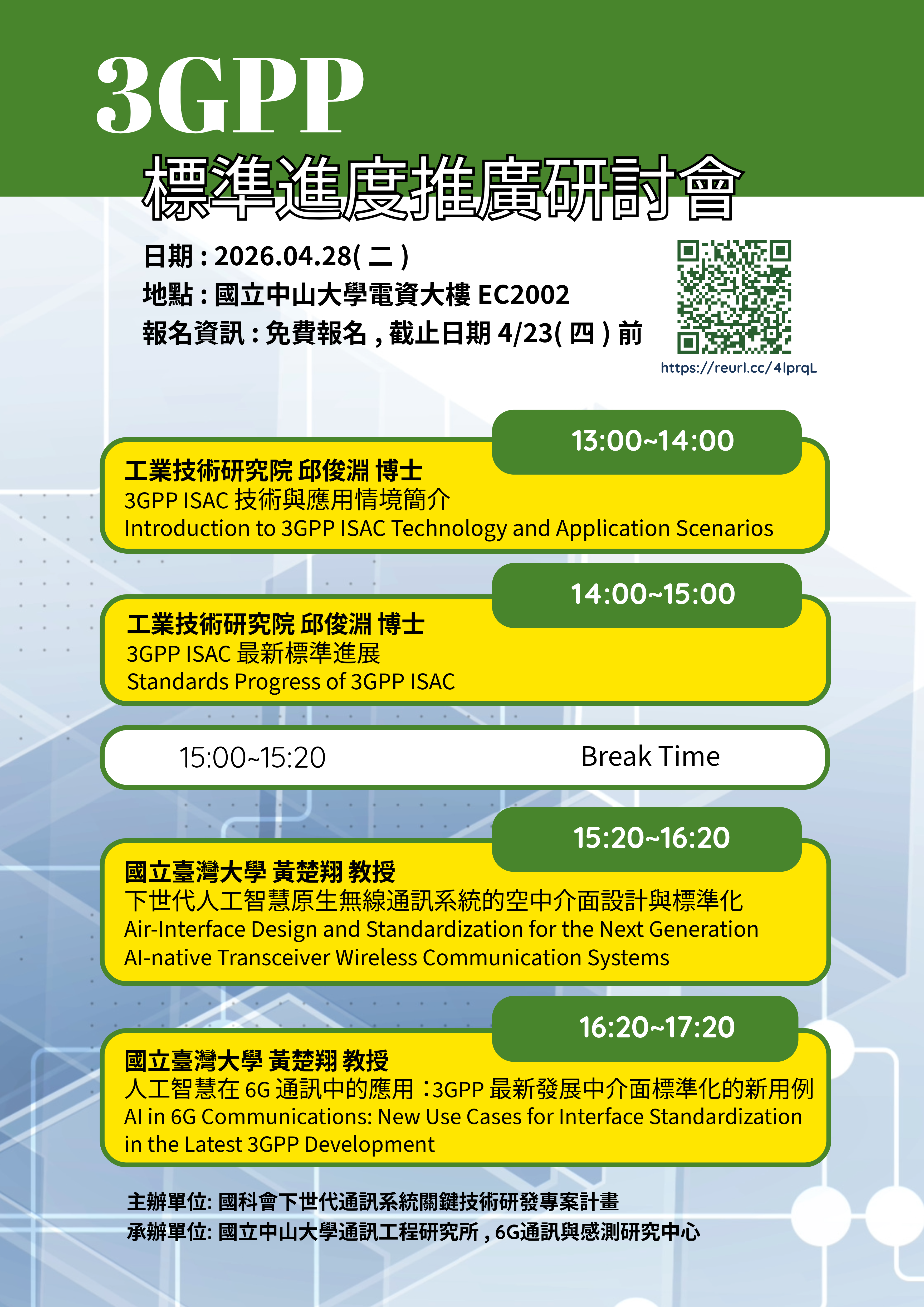
講者: 工業技術研究院 邱俊淵 博士
演講一:3GPP ISAC 技術與應用情境簡介 (Introduction to 3GPP ISAC Technology and Application Scenarios)
Integrated Sensing and Communication (ISAC) is a transformative technology that enables 5G-Advanced and future 6G infrastructures to sense the physical environment using radio signals. By utilizing NR radio frequency signals, the system can estimate parameters such as signal strength, delay, Doppler shift, and angle information to extract features like object location, velocity, and geometric information. This presentation introduces the fundamental concepts of ISAC, including monostatic, bistatic, and multistatic sensing modes. Furthermore, it explores a wide range of vertical application scenarios identified by 3GPP, such as intruder detection in smart homes, low-altitude UAV supervision, AGV tracking in smart factories, and assisted automotive maneuvering for smart transportation. The session aims to provide a comprehensive overview of how ISAC enhances the value of telecommunication infrastructure by providing high-accuracy sensing services alongside traditional communication.
演講二:3GPP ISAC 最新標準進展 (Standards Progress of 3GPP ISAC)
This presentation provides an update on the latest standardization activities of ISAC within 3GPP, covering progress from Release 19 to Release 20. In Rel-19, the focus was on service requirements (TS 22.137) and feasibility studies (TR 22.837), alongside the establishment of channel models for frequencies up to 100 GHz (TR 38.901) to support object detection and tracking. The session delves into the ongoing Rel-20 study items, highlighting key architectural enhancements in SA2 (TR 23.700-14) to support sensing management functions and exposure of results to third-party consumers. Additionally, it covers the technical progress in RAN3 (TR 38.765) regarding network architecture and signaling procedures for gNB-based monostatic sensing, particularly for UAV detection use cases. Finally, the presentation discusses the 6G timeline and how ISAC serves as a foundational technology for the next generation of mobile systems.
講者: 國立臺灣大學 黃楚翔 博士
演講三:下世代人工智慧原生無線通訊系統的空中介面設計與標準化 (Air-Interface Design and Standardization for the Next Generation AI-native Transceiver Wireless Communication Systems)
The performance improvement by adapting AI models in the communication systems is widely recognized by the research communities, and it leads to the standardization of air-interface design enabling wider and more efficient application of AI models in the communication system. In this presentation, we explain air-interface standardization achievement in 3GPP, which started in 5G-advanced, and carry on to 6G as one of the most important pillars of the next generation communication systems. We cover the general framework and use case discussions, including the interface design methodologies, specification and standardization procedures, and explain the new challenges encountered when implementing AI/ML models in the end-to-end physical layer systems. We conclude the presentation by envisioning the AI-native end-to-end transceiver systems integrated into cellular communication system as one of the most promising directions towards the next generation wireless communication systems.
演講四:人工智慧在 6G 通訊中的應用:3GPP 最新發展中介面標準化的新用例 (AI in 6G Communications: New Use Cases for Interface Standardization in the Latest 3GPP Development)
The evolution toward 6G communications necessitates an intelligent air interface capable of addressing complex, non-linear wireless challenges that traditional mathematical models struggle to resolve. This presentation outlines the 3GPP 6G study items focused on AI/ML-enhanced Radio Access Networks (RAN), specifically emphasizing use cases for interface standardization. Central to this development are several critical use cases identified for 6G interface design covered in this presentation. We first introduce the use cases in channel state information (CSI) and estimation, which focusing on the reference signal and reporting mechanism design to utilize neural networks for non-linear channel estimation and CSI encoding, decoding, and compression to reduce feedback overhead while improving reconstruction accuracy. Along this direction, we can first investigate the application of AI on Demodulation Reference Signal (DMRS) enhancement, cross-frequency CSI prediction. Power amplifier (PA) non-linearity compensation is another interesting use case discussed in 6G to leverage the strong capability of AI to learn and compensate the highly non-linear distortion in near saturation region of PA to further explore the high power transmission region of uplink. Mobility and Radio Resource Management (RRM) related measurement procedure is an important area of improvement by AI discussed in 3GPP, aiming at reducing measurement overhead and handover/radio link failure induced connection disruption. Finally, token communication, or mobile AI based service/traffic is an important and novel use case studied in 6G interface design, which explores the 6G system design shifting from bit-stream quality-centric to service quality-centric by using AI to tokenize source information, enabling error-tolerant communication tailored for AI services.
主辦單位:國科會下世代通訊系統關鍵技術研發專案計畫
協辦單位:國立中山大學通訊工程研究所, 6G通訊與感測研究中心