<Seminar> Seminar on 3GPP Standards Progress
Seminar on 3GPP Standards Progress
Date: Tuesday, April 28, 2026
Time: 1:00 PM – 5:30 PM
Venue: National Sun Yat-sen University (NSYSU)
Join us for our signature 3GPP Academic Workshop at NSYSU!
As we reach mid-2026, the development of 3GPP Release 20 (Rel-20) is moving forward at full speed. This release serves as a critical milestone, further enhancing 5G-Advanced capabilities while accelerating research and standardization for 6G technologies, effectively bridging current mobile networks with the next generation.
This seminar will focus on the latest progress within 3GPP Rel-20, exploring the architectural evolution and application scenarios of Integrated Sensing and Communication (ISAC). We will also examine the standardization and key challenges of AI/ML in wireless communication systems. Additionally, the sessions will analyze emerging 6G use cases for intelligent air-interface design, including channel estimation, resource management, and AI-driven service-based communications.
We cordially invite experts from academia and industry, professors, and graduate students to join this exchange. Let’s spark innovation and explore the possibilities of merging communication and intelligence.
Do not miss this opportunity. Register now!
Online Registration: https://www.beclass.com/rid=30525e769c61a4eb71a0
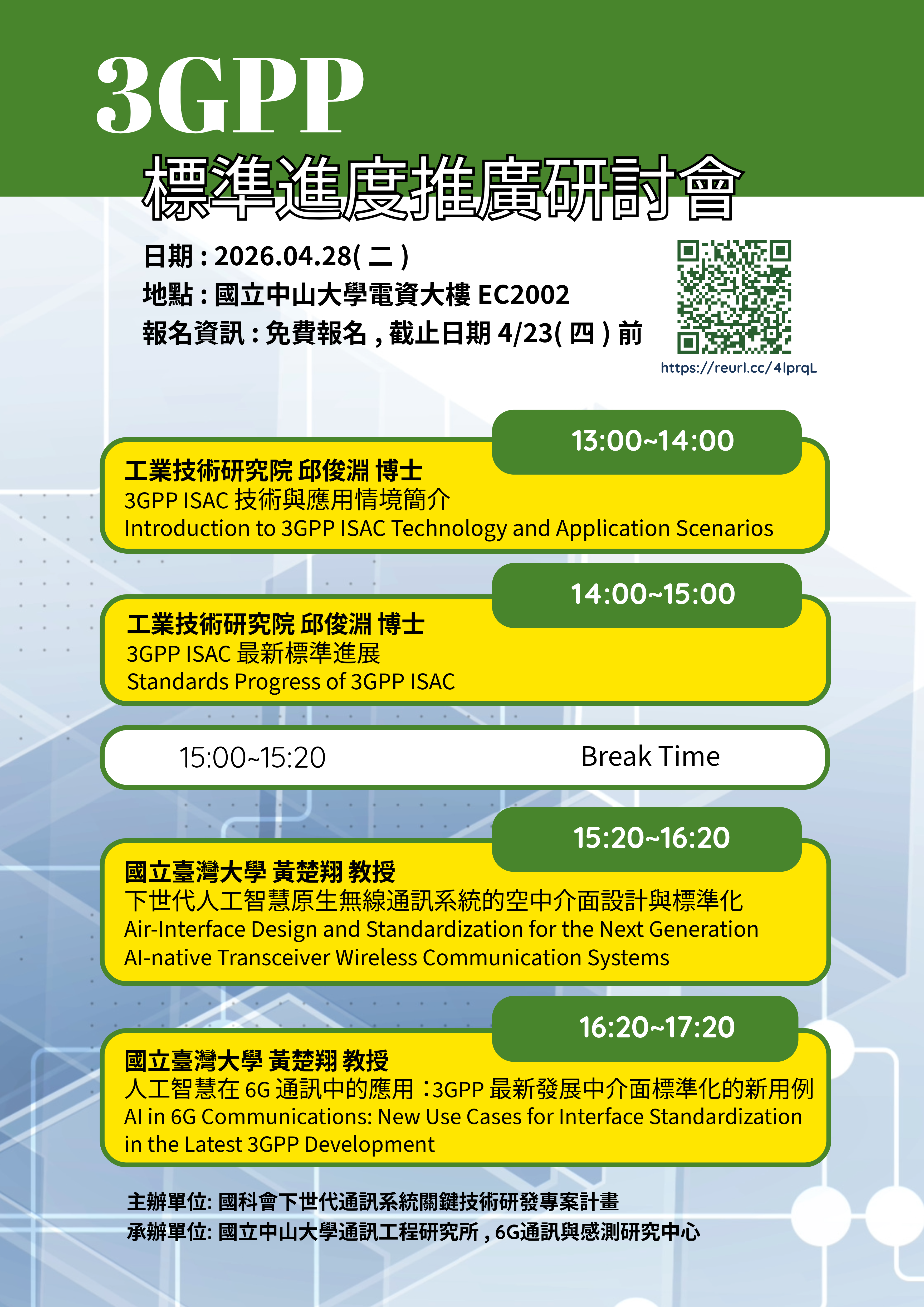
Speaker: Dr. Chun-Yuan Chiu, Industrial Technology Research Institute (ITRI)
Session 1: Introduction to 3GPP ISAC Technology and Application Scenarios
Integrated Sensing and Communication (ISAC) is a transformative technology that enables 5G-Advanced and future 6G infrastructures to sense the physical environment using radio signals. By utilizing NR radio frequency signals, the system can estimate parameters such as signal strength, delay, Doppler shift, and angle information to extract features like object location, velocity, and geometric information. This presentation introduces the fundamental concepts of ISAC, including monostatic, bistatic, and multistatic sensing modes. Furthermore, it explores a wide range of vertical application scenarios identified by 3GPP, such as intruder detection in smart homes, low-altitude UAV supervision, AGV tracking in smart factories, and assisted automotive maneuvering for smart transportation. The session aims to provide a comprehensive overview of how ISAC enhances the value of telecommunication infrastructure by providing high-accuracy sensing services alongside traditional communication.
Session 2: Standards Progress of 3GPP ISAC
This presentation provides an update on the latest standardization activities of ISAC within 3GPP, covering progress from Release 19 to Release 20. In Rel-19, the focus was on service requirements (TS 22.137) and feasibility studies (TR 22.837), alongside the establishment of channel models for frequencies up to 100 GHz (TR 38.901) to support object detection and tracking. The session delves into the ongoing Rel-20 study items, highlighting key architectural enhancements in SA2 (TR 23.700-14) to support sensing management functions and exposure of results to third-party consumers. Additionally, it covers the technical progress in RAN3 (TR 38.765) regarding network architecture and signaling procedures for gNB-based monostatic sensing, particularly for UAV detection use cases. Finally, the presentation discusses the 6G timeline and how ISAC serves as a foundational technology for the next generation of mobile systems.
Speaker: Dr. Chu-Hsiang Huang, National Taiwan University
Session 3: Air-Interface Design and Standardization for the Next Generation AI-native Transceiver Wireless Communication Systems
The performance improvement by adapting AI models in the communication systems is widely recognized by the research communities, and it leads to the standardization of air-interface design enabling wider and more efficient application of AI models in the communication system. In this presentation, we explain air-interface standardization achievement in 3GPP, which started in 5G-advanced, and carry on to 6G as one of the most important pillars of the next generation communication systems. We cover the general framework and use case discussions, including the interface design methodologies, specification and standardization procedures, and explain the new challenges encountered when implementing AI/ML models in the end-to-end physical layer systems. We conclude the presentation by envisioning the AI-native end-to-end transceiver systems integrated into cellular communication system as one of the most promising directions towards the next generation wireless communication systems.
Session 4: AI in 6G Communications: New Use Cases for Interface Standardization in the Latest 3GPP Development
The evolution toward 6G communications necessitates an intelligent air interface capable of addressing complex, non-linear wireless challenges that traditional mathematical models struggle to resolve. This presentation outlines the 3GPP 6G study items focused on AI/ML-enhanced Radio Access Networks (RAN), specifically emphasizing use cases for interface standardization. Central to this development are several critical use cases identified for 6G interface design covered in this presentation. We first introduce the use cases in channel state information (CSI) and estimation, which focusing on the reference signal and reporting mechanism design to utilize neural networks for non-linear channel estimation and CSI encoding, decoding, and compression to reduce feedback overhead while improving reconstruction accuracy. Along this direction, we can first investigate the application of AI on Demodulation Reference Signal (DMRS) enhancement, cross-frequency CSI prediction. Power amplifier (PA) non-linearity compensation is another interesting use case discussed in 6G to leverage the strong capability of AI to learn and compensate the highly non-linear distortion in near saturation region of PA to further explore the high power transmission region of uplink. Mobility and Radio Resource Management (RRM) related measurement procedure is an important area of improvement by AI discussed in 3GPP, aiming at reducing measurement overhead and handover/radio link failure induced connection disruption. Finally, token communication, or mobile AI based service/traffic is an important and novel use case studied in 6G interface design, which explores the 6G system design shifting from bit-stream quality-centric to service quality-centric by using AI to tokenize source information, enabling error-tolerant communication tailored for AI services.
主辦單位:國科會下世代通訊系統關鍵技術研發專案計畫
協辦單位:國立中山大學通訊工程研究所, 6G通訊與感測研究中心