
2024 Highlights
1. Campus Hotspot 6G Advanced MIMO System
In 2023, our center deployed a globally-leading 6G upper-mid-band advanced MIMO system on the NSYSU campus. In real outdoor crowd-gathering environments, we achieved operation of a 16×8 MIMO system on the 7.1 GHz band, reaching a terminal spectral efficiency of 45 bps/Hz. Meanwhile, in the EECS building's open space, a 16×12 MIMO system at 7.1 GHz achieved over 60 bps/Hz spectral efficiency. Both results significantly exceed the spectral efficiency of current 4×4 MIMO systems on 5G mid-band (3.5 GHz), which typically reach only about 15 bps/Hz.
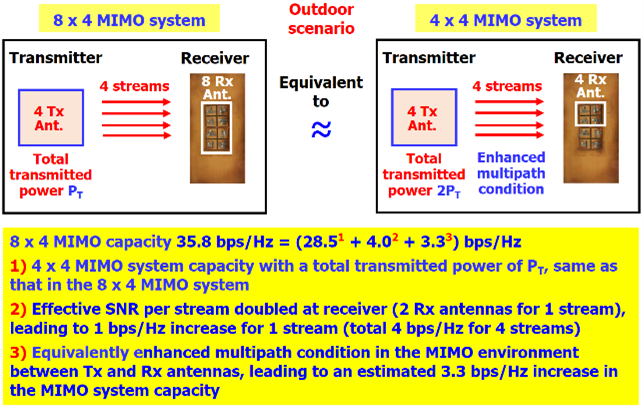
In 2024, we proposed the first equivalent system model based on Extreme Receive Antennas (ERA)-aided MIMO. By embedding high-density MIMO antennas at least twice the spatial streams inside mobile terminals and maintaining the same base station power, this setup can surpass transmission data rates of ideally rich multipath MIMO systems. This is particularly suitable for upper-mid-band MIMO systems, aiding in the explanation and prediction of 6G terminal performance (Figure 1). Even for handheld scenarios, this technology achieves four times the spectral efficiency compared to current 5G systems under the same conditions (Figure 2).
Notably, compared with the use of 8 or 12 spatial streams in 2023, we adopted 4 streams in 2024 to reduce system complexity and energy consumption at the base station. By applying ERA-aided MIMO, we still achieved multiplicative improvements in spectral efficiency at minimal complexity and power cost, enhancing practical feasibility for 6G MIMO applications. In 2025, we will focus on connecting with international teams to validate their R&D results in our MIMO platform demonstration field.
(a) (b)
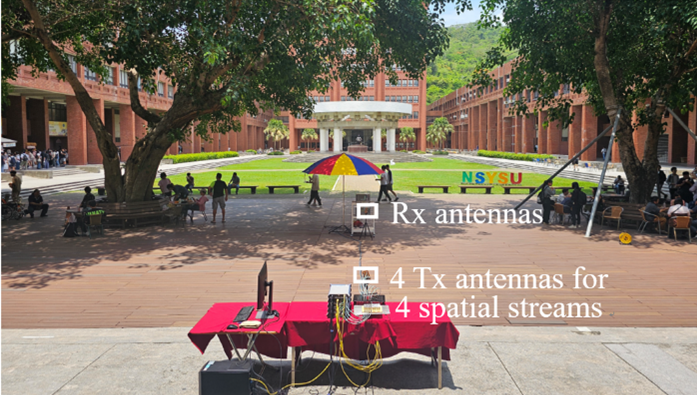
Figure 1: Equivalent system modeling for ERA-aided MIMO: (a) Campus outdoor crowd-gathering environments (150m in length and 50m in width) test scenario; (b) The measured 8×4 MIMO channel capacity can be equivalent to the measured 4×4 MIMO channel capacity obtained by using twice the transmit power (2PT) at the Tx and enhanced multipath power.
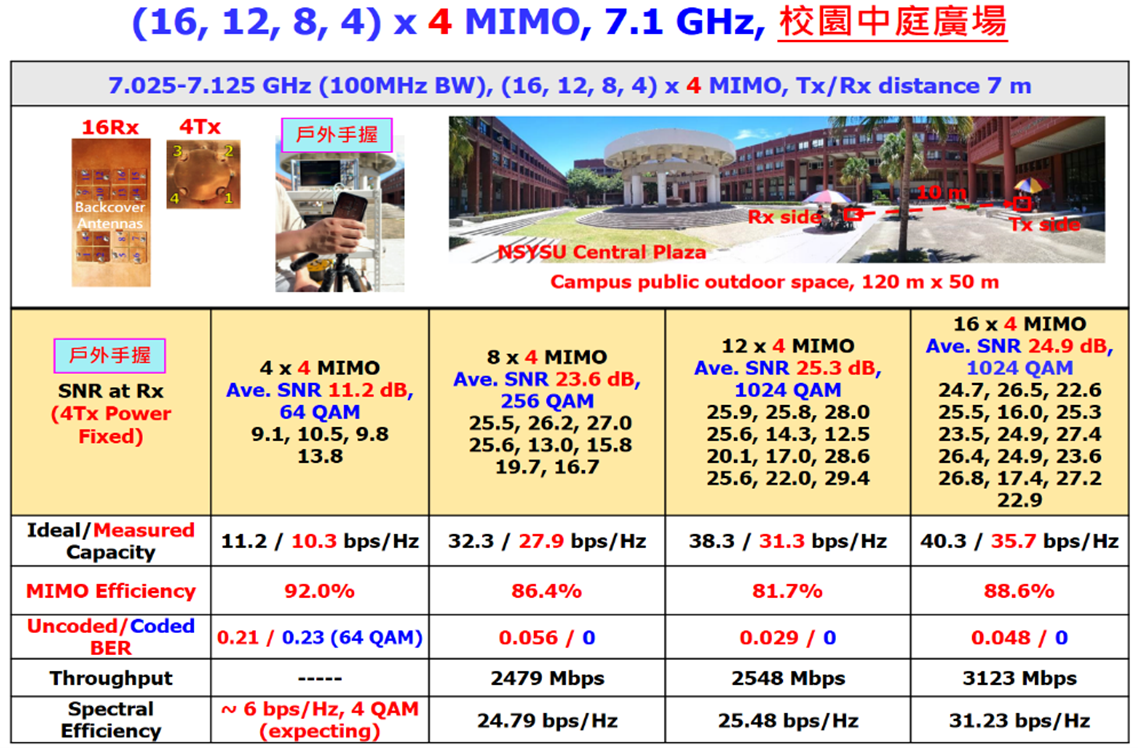
Figure 2 (16, 12, 8) × 4 MIMO in the National Sun Yat-sen University campus outdoor crowd-gathering plaza handhold scenario achieved the terminal spectrum efficiency about 25~31 bps/Hz. Compared with 4 × 4 MIMO outdoor handhold scenario only up to about 6 bps/Hz, the transmission rate of more than four times is obtained, highlighting the ERA-aided MIMO technology can achieve a stable and high-speed data transmission.
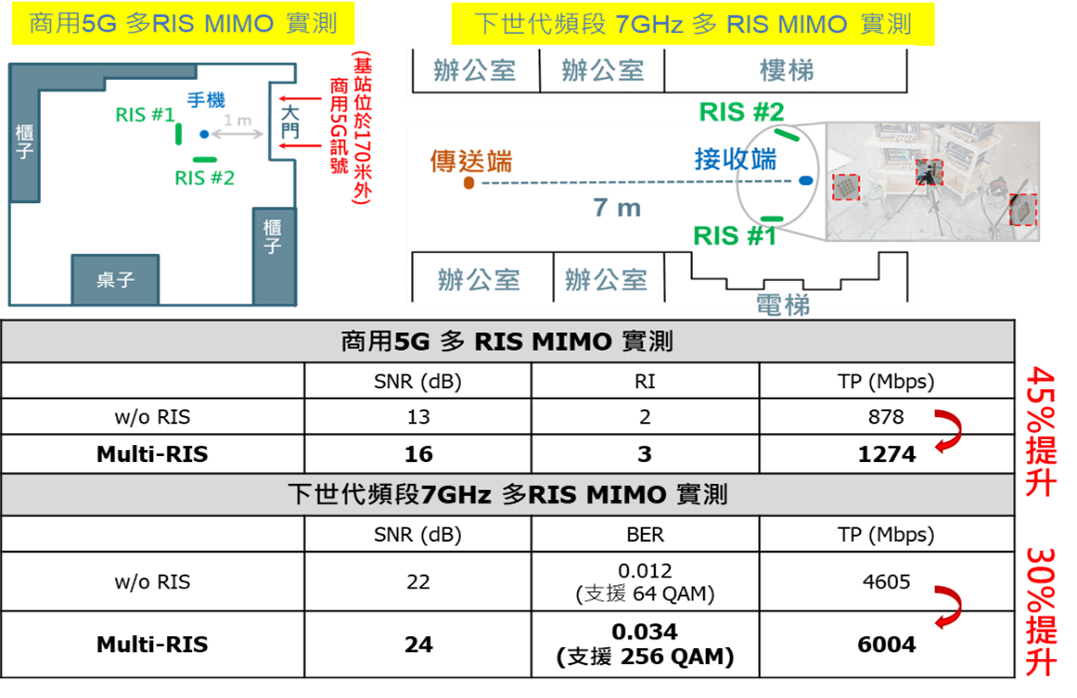
Figure 3: Commercial 5G and Next-Generation Multi-RIS MIMO Validation (top left) Commercial 5G test site; (top right) Next-Generation 7GHz band test site. Multi-RIS technology achieves 45% throughput improvement in commercial environment and 30% throughput improvement in 7GHz band.
We also successfully completed a commercial 5G communication test at 3.5 GHz using multiple reconfigurable intelligent surface (RIS) devices, with commercial smartphones receiving signals from commercial base stations (Figure 3, top left). Results confirmed that multi-RIS not only effectively covers blind spots but also significantly increases channel rank, boosting system throughput by 44%. This represents the first successful global demonstration of MIMO rank enhancement in commercial 5G environments.
In addition, we conducted communication tests on 7 GHz band, which is regarded as a next-generation frequency band, using our self-developed base stations and 16×12 MIMO systems (Figure 3, top right). Multiple RIS units were deployed to improve signal quality. Originally supporting only 64QAM, the system was upgraded to 256QAM via RIS processing, increasing overall throughput by 30%. By amplifying signal energy and focusing it through phase shifters, multi-RIS systems dramatically improved communication performance in NLOS scenarios. From 5G to 6G frequency bands, multi-RIS has shown excellent potential and practical commercial feasibility, laying a strong foundation for 6G.
2 Mid-to-High Frequency 6G MIMO Radar Sensing System Testing
This research focuses on developing MIMO radar sensing systems across millimeter wave, terahertz, and mid-to-high frequency bands, evaluating sensitivity, positioning accuracy, resolution, and NLOS detection capability, with applications in human positioning and physiological sensing.
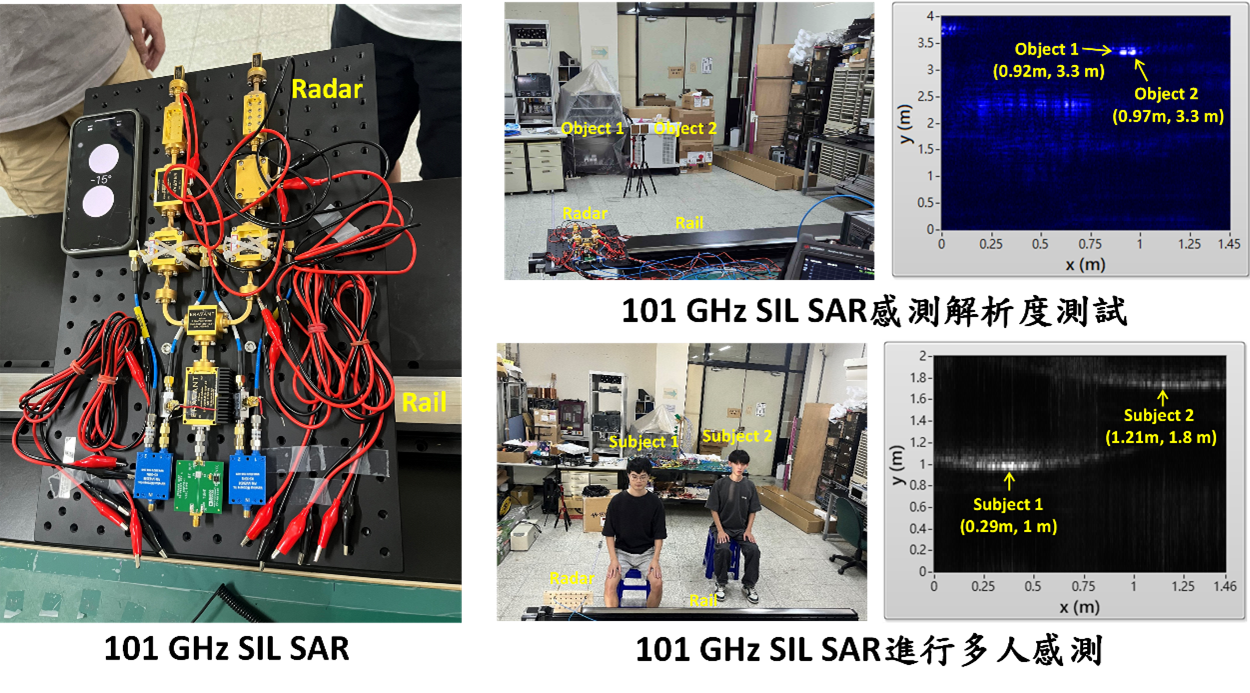
Figure 4: MIMO radar sensing systems
We are applying radar sensing technology to develop new automotive sensors in 2025. These sensors will be installed in other locations like the driver's seat area, A-pillar, and B-pillar. These sensors will be able to immediately obtain the vital signs of the driver and the presence of living organisms in the vehicle. When the vehicle is turned off or idling and there are no vital signs in the driver's seat, the radar sensors can accurately determine whether there are people in the vehicle, with an estimation accuracy exceeding 40%. While the vehicle is in motion, the sensor continuously tracks the driver's vital signs and assesses the driver's fatigue level by analyzing the correlation between respiration and heart rate variability. The predicted accuracy of the vital signs sensing is 90% for both respiration and heart rate. The driving fatigue level is categorized into mild and severe based on relevant characteristics in order to provide appropriate alerts.