
2025 Highlights
1. Educating Talent
- Leading Academic Impact: Papers average 22.3 citations and an FWCI of 1.90, well above global averages. Q1 journal publications reach 93.5%, with 70.8% involving international collaboration. The Telecommunication Engineering program ranked #1 in Taiwan in the 2025 ShanghaiRanking (GRAS).
- Integrating Theory and Practice: Graduate training combines solid theoretical foundations with real-world applications through global research projects, industry partnerships, and system-level integration.
- Talent Recruitment & Global Visibility: Recruited 12 international researchers and added 2 IEEE Fellows to the faculty. Demonstrating top-tier training capacity, a Ph.D. alumna was named among the 2025 100 Outstanding Women in 6G.
- International Exchange & Recruitment: Reciprocal visits with universities in Indonesia, India, and Vietnam have yielded tangible results in international recruitment and talent development.
- Global Horizon & Competitiveness: Students are actively encouraged to join international conferences and overseas exchanges to boost their research skills and global outlook.
2. Academic Performance
2.1 Breakthroughs in 6G Upper Mid-Band and Collaborative Communications:
Partnering with LG Innotek and MediaTek, the center integrated miniaturized 6G upper mid-band terminal MIMO antenna modules into hybrid 5G/6G smartphone prototypes and completed 7.1 GHz high-order MIMO field tests at Sun Yat-sen University. Verified with global terminal and chipset leaders, this milestone elevates the campus testbed from a research platform to an internationally recognized industrial validation node. Additionally, physical trial of the User Equipment Collaborative MIMO (UE-CoMIMO) architecture was completed in a commercial 5G FR1 environment, dynamically scaling antenna counts via multi-device collaboration. This feature was highlighted by MediaTek as a key 6G use case during Keynotes at COMPUTEX 2025 and GLOBECOM 2025.
2.1a Campus Hotspot 6G Advanced MIMO System
The team established a world-leading 6G upper mid-band high-order MIMO testbed at National Sun Yat-sen University (NSYSU) and pioneered Extreme Receive Antennas-aided MIMO (ERA-aided MIMO) technology. Collaborating with LG Innotek (Seoul) and MediaTek, the team integrated miniaturized 6G ceramic MIMO antenna modules and hybrid 5G/6G smartphone prototypes into 7.1 GHz field tests on campus. The trials achieved stable high-speed transmission as expected, validating that the team's next-generation smartphone antenna architecture matches commercial performance standards. Figure 1.1 illustrates the campus field tests for the hybrid 5G/6G MIMO system (comprising 4 frame and 4 back-cover antennas).
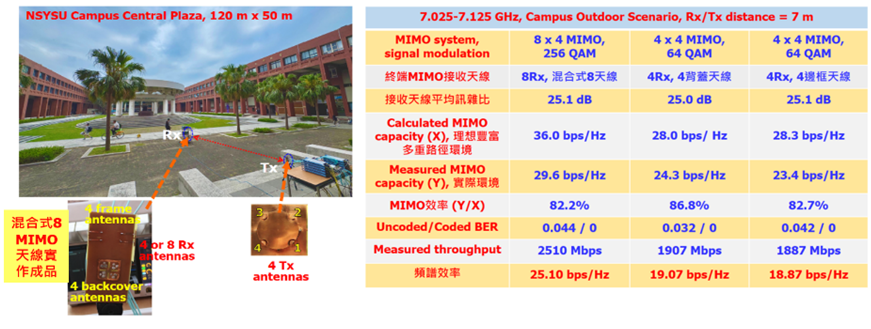
Figure 1.1 Implementation and Outdoor MIMO Performance Validation of a Hybrid 8-MIMO Antenna System (4 Ultra-Wideband Frame Antennas Covering 5G/6G 3.3–8.4 GHz + 4 Back-Cover Antenna Modules Covering 6G 6.4–8.4 GHz) : The hybrid MIMO antenna architecture covers multi-antenna operations across 5G/6G bands, offering a rapid deployment strategy for future 5G/6G smartphones while achieving a spectral efficiency of 25 bps/Hz via 8×4 MIMO in the 6G band. This deployment design also serves as a third-party prototype validation platform for domestic industry, yielding expected performance metrics across both 4×4 and 8×4 MIMO configurations.
The team developed a ultra-compact upper mid-band MIMO antenna module occupying an area of just 0.24λ2 for four antennas, integrating four closely spaced elements within the footprint of a conventional single antenna (around 0.25λ2). Pioneering this approach globally, we leveraged these compact modules to demonstrate 8x4 MIMO utilizing ERA-aided technology (using 8 terminal antennas to receive 4 spatial streams). As shown in Figure 1.2, this configuration achieves a spectral efficiency superior to an 8x8 system with significantly reduced system complexity and higher energy efficiency. These findings further validate the efficacy of ERA-aided MIMO and substantially enhance its practical value for future 6G upper mid-band deployments.
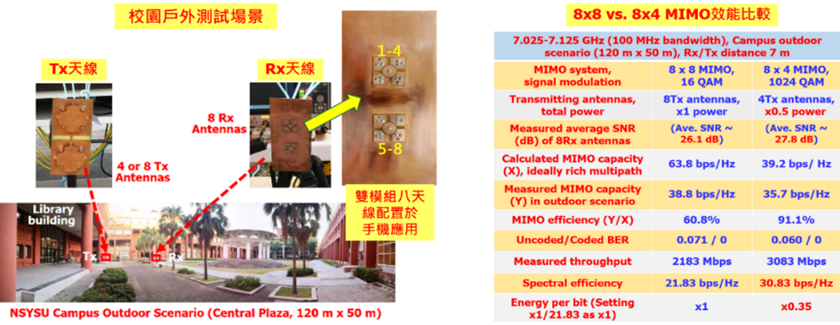
Figure 1.2 Campus Outdoor 8×4 vs. 8×8 MIMO Evaluation of a High-Density 6G Upper Mid-Band (6.425–8.4 GHz) 4-Antenna Module (Area: 0.24λ2 @ 6.425 GHz) and Its Dual-Module 8-Antenna Deployment: Experimental results demonstrate that the high-density 4-antenna MIMO module maintains excellent MIMO characteristics. In campus outdoor tests, the 8×4 MIMO configuration successfully supported 1024-QAM, achieving a spectral efficiency of 30.83 bps/Hz. This performance surpasses the more complex 8×8 MIMO system, which yielded 21.83 bps/Hz (limited to 16-QAM). Furthermore, the 8×4 MIMO setup exhibited superior energy efficiency, requiring only 35% of the energy per bit transmitted by the 8×8 system (0.35x), thereby validating the efficacy of ERA-aided MIMO.
The team proposed the User Equipment Cooperative MIMO (UE-CoMIMO) framework, enabling a primary UE to form a virtual antenna array with surrounding collaborative UEs. Upon receiving base station signals, collaborative UEs perform frequency translation and relay the signal to the primary UE over unused high frequency bands (e.g., 7 GHz or 28 GHz). This cross-band signal aggregation dynamically expands the effective antenna array, significantly enhancing communications performance and spectral efficiency.
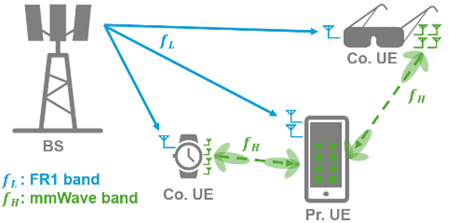
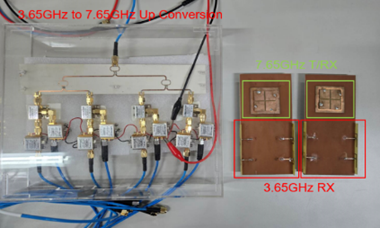
Figure 1.3 Application Scenarios and Transceiver/Frequency-Translation System Implementation for UE-CoMIMO
(Left: Schematic Diagram of Device-Cooperative Scenarios; Right: Physical Photograph of the 3.65–7.65 GHz Collaborative UE Frequency-Translation System)
The team evaluated signal reception and system performance in a laboratory setup at a base station distance of 144 meters. As shown in (a) and (b), both the primary UE and collaborative UE were equipped with dual 3.5 GHz and 7 GHz antennas. The collaborative UE upconverted the received base station signals to 7 GHz and relayed them to the primary UE for joint combining. Experimental results in (c) demonstrate that this architecture effectively increases spatial multiplexing capacity and throughput.
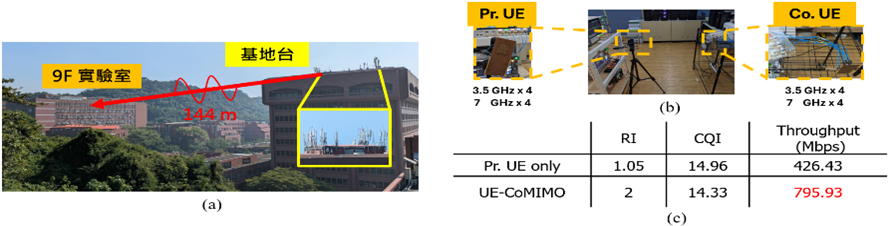
Figure 1.4 Experimental Setup and Performance Validation for Commercial Signal Reception in UE-CoMIMO: (a) Test Scenario from Base Station to Terminals; (b) Laboratory System Configuration; (c) System Performance Results
These research achievements have garnered significant attention from both industry and the global academic community. In collaboration with MediaTek, the team demonstrated device-cooperative communication technology supporting hybrid AI computing at COMPUTEX 2025 as a key 6G application scenario. Furthermore, Dr. Ming-Xi Fan, Senior General Manager at MediaTek, highlighted UE-CoMIMO as one of MediaTek's four core 6G use cases during his keynote speech at GLOBECOM 2025 (December 12, 2025).
At the global consensus level, Japan's XG Mobile Promotion Forum (XGMF) explicitly listed User Equipment Cooperative MIMO (UE-CoMIMO) as a potential key 6G technology in its white paper, demonstrating the broad cross-industry and international impact of this research.
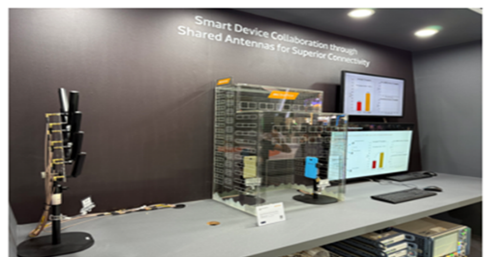
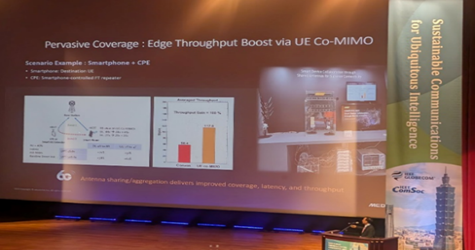
Figure 1.5 Industry Showcase and International Conference Highlights of UE-CoMIMO Technology: (Left) MediaTek Demonstrating the UE-CoMIMO Technology Developed by the Team at COMPUTEX; (Right) MediaTek Senior General Manager Dr. Ming-Xi Fan Highlighting UE-CoMIMO as a Key 6G Use Case in GLOBECOM 2025 Keynote Speech
2.2 Breakthroughs in 6G MIMO Radar Sensing and ISAC Systems
Combining academic and industrial capabilities from NXP and the Taiwan Semiconductor Research Institute (TSRI), the center's sensing team developed integrated millimeter-wave (mmWave) and terahertz (THz) MIMO radar technologies. The team successfully realized mmWave in-cabin sensors and THz 4D MIMO radar systems for applications including Child Presence Detection (CPD), driver fatigue monitoring, and human imaging for physiological measurements, demonstrating high integration density and high-resolution performance.
2.2a In-Cabin Child Presence Detection (CPD)
This study validates the proposed CPD framework using real-world millimeter-wave (mmWave) radar measurements. By employing virtual element (VE) techniques to enhance spatial resolution, the system effectively distinguishes between the driver seat and other passenger locations. Furthermore, a generalized likelihood ratio test (GLRT) is integrated to significantly improve vital sign detection sensitivity under weak-signal conditions. Experimental results demonstrate that under engine-off or idling conditions without driver vital signs, the system achieves detection within approximately 5 seconds, maintaining an overall accuracy exceeding 90%. These findings confirm high feasibility for automotive safety and smart cabin applications.
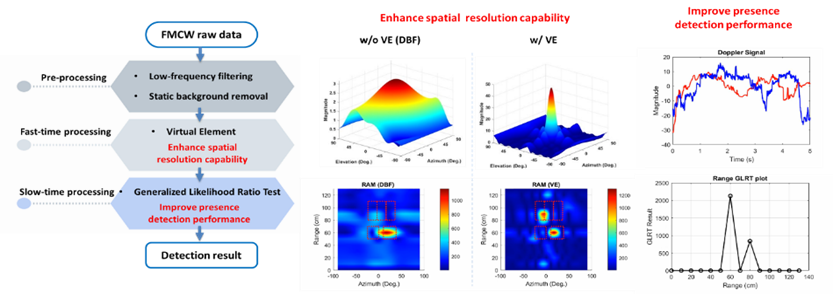
Figure 2.1 Flowchart of the mmWave radar sensing algorithm for Child Presence Detection (CPD). Key technical highlights include spatial resolution enhancement via virtual element (VE) technology and enhanced vital sign detection integrated with the Generalized Likelihood Ratio Test (GLRT).
2.2b In-Cabin Driver Fatigue Monitoring
Leveraging the 3D positioning capability of commercial millimeter-wave (mmWave) radar, the system effectively isolates the driver from front-passenger and rear-seat occupants, accurately capturing minute chest displacement phase shifts while suppressing multi-target interference and clutter. For demodulation, channel-compressed demodulation (CCD) is adopted to refine phase estimation accuracy under micro-displacement conditions. For heartbeat extraction, an ECG-based PRT model is integrated to correct peak offset issues, substantially improving the accuracy of R-peak interval estimation. The results lead to a 91.67% accuracy rate within an instantaneous heart rate error margin of ±7 bpm. Because respiratory-induced chest displacement is approximately ten times that of cardiac activity, the average breathing rate estimation accuracy reaches 99%.
For fatigue state assessment, this study employs cardiopulmonary coupling (CPC) metrics grounded in respiratory sinus arrhythmia (RSA). RSA is a physiological mechanism where heart rate accelerates during inhalation and decelerates during exhalation, mediated by parasympathetic activity. Under fatigue or stress, elevated sympathetic tone increases heart rate and reduces CPC degree. To quantify this effect, Ensemble Empirical Mode Decomposition (EEMD) is applied to R-peak interval sequences and respiratory signals, selecting intrinsic mode functions (IMFs) with high energy in the breathing band based on spectral characteristics. Instantaneous phase is subsequently estimated via Hilbert transform to compute heart-respiration phase differences, defining a cardiopulmonary synchronization index. Experimental results demonstrate that when this synchronization index drops below 0.5, subjects consistently correspond to high fatigue levels (Levels 7–9) on the Karolinska Sleepiness Scale (KSS), establishing an effective metric for real-time fatigue alerting and driving safety evaluation.
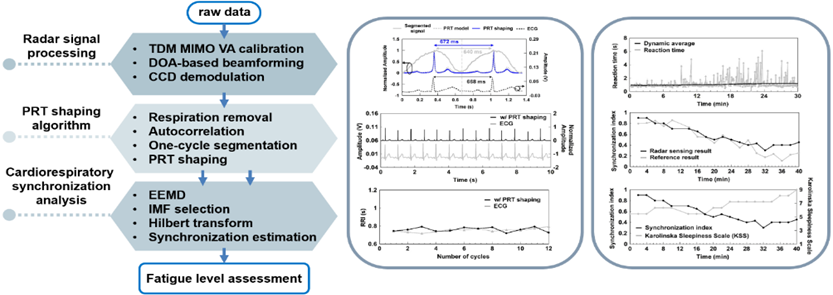
Figure 2.2 Algorithm architecture for contactless driver fatigue assessment. Key technical highlights include integrating channel-compressed demodulation (CCD) with a PRT model to enhance instantaneous heart rate estimation accuracy and evaluating fatigue states based on the degree of cardiopulmonary coupling.
2.2c Terahertz-Band MIMO 4D Radar Systems
In collaboration with National Tsing Hua University, National Yang Ming Chiao Tung University, and the Taiwan Semiconductor Research Institute (TSRI) under the NSTC Key Technologies for Next-Generation Communication Systems Project, the center's sensing team developed a terahertz-band MIMO 4D radar system. This joint effort successfully established a comprehensive terahertz sensing technology chain encompassing RF chip development, antenna packaging, signal processing, and application validation.
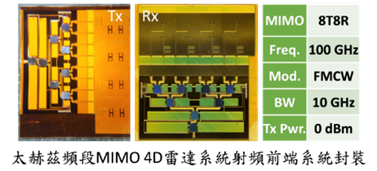
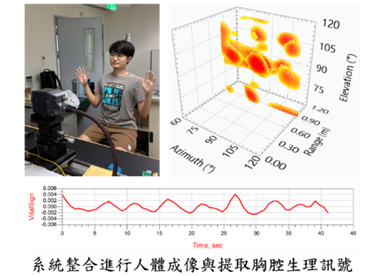
Figure 2.3 System Integration and Testing of the Terahertz-Band MIMO 4D Radar
3. International Collaboration and Exchanges
To foster international exchange and align with world-class research, the center has invited renowned scholars in 6G communications and artificial intelligence from various countries on multiple occasions. These activities not only expose participants to the latest advances in communication technologies, but also provide opportunities to showcase and interactively demonstrate our self-developed 6G MIMO communication platform. Additionally, the team participated in the EU 6G-SANDBOX project, successfully completing a multinational demonstration of integrated sensing and communication (ISAC) systems.
Led by ITRI, the center collaborated with academic and industrial partners, including BubbleRAN, G REIGNS, Groundhog, and National Yang Ming Chiao Tung University, to deliver an “All-Round Indoor/Outdoor ISAC Geofencing Solution,” at IEEE GLOBECOM 2025 (Figure 3.1). By leveraging the sensing capabilities of 6G wireless signals, this solution achieves precise crowd control and spatial security monitoring without relying on traditional camera-based surveillance, demonstrating the practical potential of 6G communication and sensing convergence.
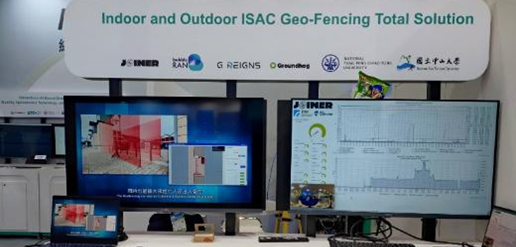
Figure 3.1 The center's participation in the EU 6G-SANDBOX testbed project: ITRI demonstrating multinational collaborative research outcomes with the EU 6G-SANDBOX (the world's largest 6G experimental network platform) and the UK JOINER 6G initiative at IEEE GLOBECOM 2025.
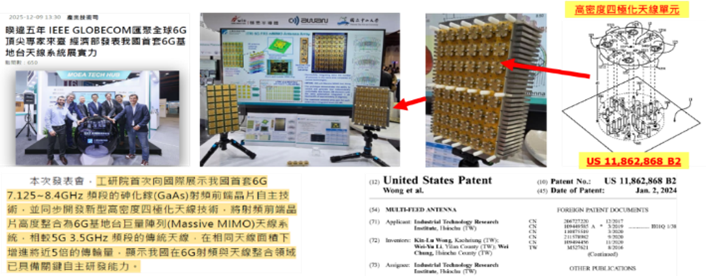
Figure 3.2 6G base station Massive MIMO array incorporating team-pioneered high-density quad-polarized antenna elements, developed in collaboration with ITRI: ITRI showcased Taiwan's first 6G 7.125–8.4 GHz base station antenna system at GLOBECOM 2025, delivering a 5-fold throughput increase over conventional 5G 3.5 GHz antennas within the same antenna footprint.
The center's sensing team continues to deepen its collaboration with its benchmark center, the Mærsk Mc-Kinney Møller Institute (MMMI) at the University of Southern Denmark (SDU), advancing radar-centric contactless health monitoring research. In 2025, the team signed a research collaboration agreement with the Department of Science and Technology (ITN) at Linköping University (LiU), Sweden, to integrate health-monitoring radar into 6G ISAC architectures. Their recent tripartite publication, Highly Penetrative Chest-Worn Metasurface for Multi-Angle RADAR-Based Vital Sign Monitorin (Figure 3.3), was published in July 2025 at EMBC 2025, the flagship IEEE biomedical engineering conference.
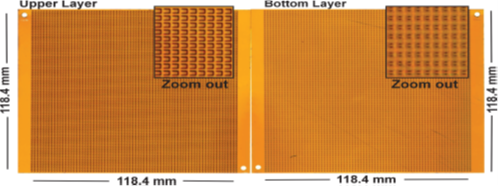
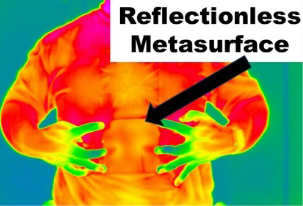
Figure 3.3 Chest-worn reflection-suppression metasurface structure (left) and its infrared thermal image (right), demonstrating effective radar electromagnetic wave penetration into human tissue.
4. Social Contribution
Deepened Industry-Academia and Societal Impact: Executed 32 industry-academia collaboration projects totaling NT$181 million, shifting focus from quantity to quality to build a sustainable 6G R&D and industrial integration ecosystem. Actively participated in regional industrial development in the Kaohsiung-Pingtung area, communication antenna design competitions, and technology outreach. Demonstrated the social responsibility and long-term impact of academic research through public engagement in professional societies and organizations.
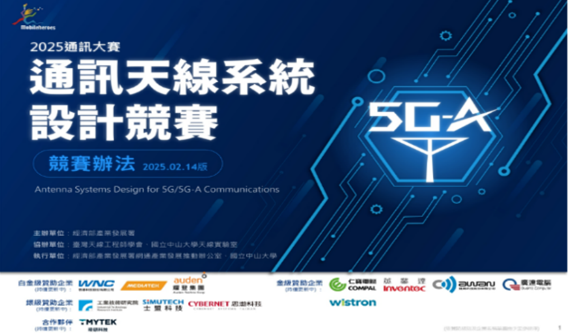
Figure 4.1 2025 Mobileheroes National Communication Competition – Communication Antenna System Design Contest (https://mobilehero.com/zh-Hant/antenna)
5. Planning and Execution of International Conferences
Prof. Tzyy-Sheng Horng (Honorary Chair) and Assoc. Prof. Fu-Kang Wang (TPC Co-Chair), together with Assoc. Prof. Chung-Tse Michael Wu (NTU), successfully co-organized IEEE IMBioC 2025 at the Kaohsiung Exhibition Center (April 15–17, 2025). Attracting 132 participants from 12 countries, the conference presented 60 technical papers and featured 8 industry exhibitors, centering on non-contact vital sign monitoring, mmWave biomedical radar, and AIoT healthcare.
Keynote speaker Dr. Chien-Jen Chen (former Vice President) graced the opening ceremony alongside Kaohsiung Deputy Mayor Lin Chin-Rong and NSYSU President Dr. Chih-Peng Li. The event highlighted cross-sector alignment in smart medicine and greatly bolstered Taiwan’s international reputation in microwave biomedical sensing.
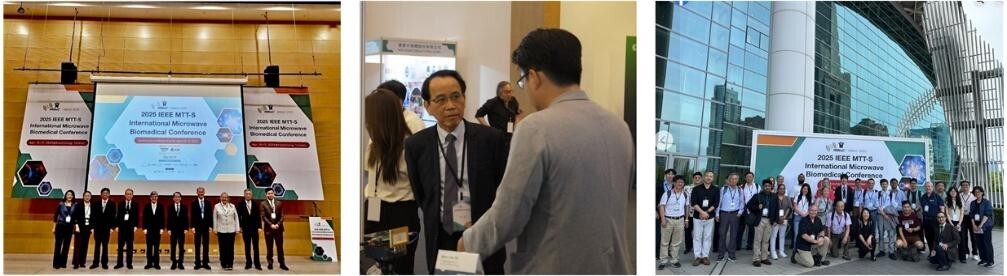
Figure 5.1 Highlights of IEEE IMBioC 2025
Prof. Chih-Peng Li (TPC Co-Chair) and Assoc. Prof. Wan-Jhen Huang co-hosted IEEE GLOBECOM 2025 in Taipei, one of the two global flagship conferences in communications. Assoc. Prof. Huang spearheaded the “Women in Communications Engineering” (WICE) and “Young Professionals” (YP) programs, facilitating intergenerational dialogue among scholars on career development, next-generation communication technologies, and emerging R&D trends to support female and early-career researchers.
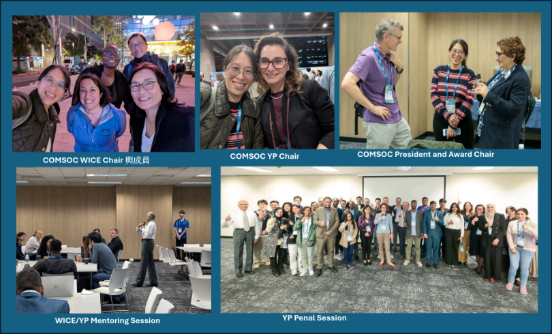
Figure 5.2 Highlights of IEEE GLOBECOM 2025
Assoc. Prof. Keshav Singh hosted the hybrid International Workshop Series on 6G (IWS-6G 2025) at NSYSU in December 2025. Featuring world-renowned speakers, the event covered cutting-edge 6G themes such as PASS/pinching beamforming, semantic communications, physical-layer AI/ML, energy-aware IoT, and federated learning to meet next-generation requirements for high performance and intelligence. The workshop served as a premier international platform to bridge 6G theory, technologies, and implementation, boosting the Center’s global reach. Day 2 featured a live demonstration of a device-collaborative MIMO system by Prof. Chao-Kai Wen’s Communications Technology Lab, highlighting breakthrough 6G system designs. With 82 on-site and 455 online participants across two days, the hybrid event drove widespread international engagement.
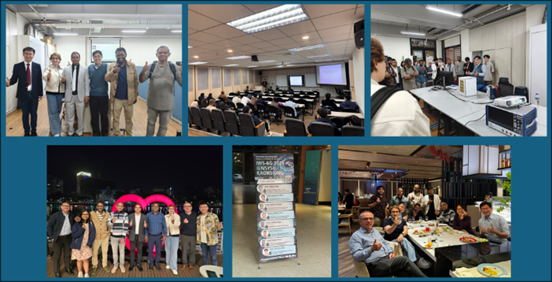
Figure 5.3 Highlights of International Workshop Series on 6G 2025 (IWS-6G 2025)